





Uncategorized
Differentiate Knee Pain by Location:
Aug
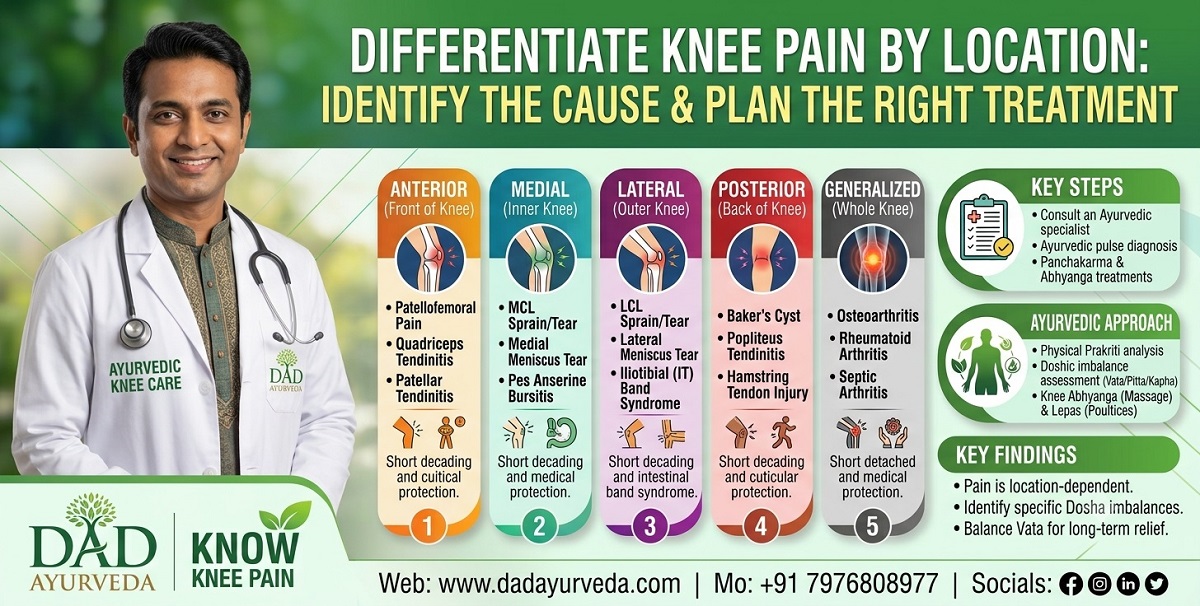
Differentiate Knee Pain by Location: Identify the Cause & Plan the Right Treatment
Knee pain is one of the most common complaints in orthopedic and physiotherapy clinics. The key to effective treatment is not just knowing that the knee hurts — it is accurately identifying where it hurts. Localization of pain is the first and most important step in narrowing the differential diagnosis before performing special tests, imaging, or starting therapy.
This clinical approach — Identify the Location → Find the Cause → Plan the Treatment — is widely used by physiotherapists and orthopedic specialists.
1. Anterior Knee Pain (Front of the Knee)
Common conditions:
- Patellofemoral Pain Syndrome
- Patellar Tendinopathy (Jumper’s Knee)
- Quadriceps Tendinopathy
- Prepatellar Bursitis
- Hoffa’s Fat Pad Impingement
Typical clinical features:
- Pain while climbing stairs, squatting, or after prolonged sitting
- Pain below the patella, aggravated by jumping and running
- Pain above the patella during resisted knee extension
- Swelling and tenderness directly over the kneecap
- Pain below the patella that worsens with full knee extension
2. Medial Knee Pain (Inner Side of the Knee)
Common conditions:
- Medial Collateral Ligament (MCL) Sprain
- Medial Meniscus Tear
- Pes Anserine Bursitis
- Medial Compartment Osteoarthritis
Typical clinical features:
- Pain after a valgus stress or twisting injury
- Joint-line pain, locking, clicking, or pain during squatting
- Pain 4–5 cm below the medial joint line with tenderness on palpation
- Pain during weight-bearing, morning stiffness, and crepitus
3. Lateral Knee Pain (Outer Side of the Knee)
Common conditions:
- Iliotibial Band (ITB) Syndrome
- Lateral Meniscus Tear
- Lateral Collateral Ligament (LCL) Sprain
- Popliteus Tendinitis
Typical clinical features:
- Pain over the lateral femoral epicondyle that worsens with running
- Lateral joint-line tenderness, locking, or clicking
- Pain after a varus stress injury
- Posterolateral knee pain during downhill walking or running
4. Posterior Knee Pain (Back of the Knee)
Common conditions:
- Baker’s Cyst
- Hamstring Tendinopathy
- Gastrocnemius Strain
- Posterior Cruciate Ligament (PCL) Injury
Typical clinical features:
- Swelling behind the knee and tightness during flexion
- Pain at the posterior knee during resisted knee flexion
- Pain in the upper calf and posterior knee during walking or push-off
- Pain after a dashboard injury or hyperflexion trauma
5. Generalized / Whole Knee Pain
Common conditions:
- Osteoarthritis
- Rheumatoid Arthritis
- Septic Arthritis
Typical clinical features:
- Diffuse pain, stiffness, reduced range of motion, and crepitus
- Bilateral pain, swelling, and prolonged morning stiffness
- Severe pain, redness, swelling, and fever (medical emergency – seek immediate care)
Quick Clinical Guide
- Pain around the kneecap → Patellofemoral pain syndrome, patellar tendinopathy, or fat-pad impingement
- Pain along the medial joint line → Medial meniscus tear or medial compartment osteoarthritis
- Pain below the medial knee → Pes anserine bursitis
- Pain on the lateral side → Iliotibial band syndrome or lateral meniscus pathology
- Pain behind the knee → Baker’s cyst, hamstring tendinopathy, gastrocnemius strain, or PCL injury
- Diffuse pain with stiffness and crepitus → Osteoarthritis
Knee Pain Localization – Key Anatomical Landmarks
Understanding surface anatomy helps clinicians and patients communicate more precisely:
- Anterior: Quadriceps tendon, patella, medial & lateral joint lines, patellar tendon, tibial tuberosity
- Medial: Medial femoral condyle, medial joint line, pes anserine region (4–5 cm below joint line)
- Lateral: Lateral femoral condyle, lateral joint line, fibular head, iliotibial band
- Posterior: Hamstring tendons, Baker’s cyst area, gastrocnemius muscle
This localization-based approach is routinely used during physiotherapy assessment to narrow the differential diagnosis before palpation, range-of-motion testing, and special orthopedic tests.
Important Note: This information is for educational purposes only and is not a substitute for professional medical diagnosis or treatment. Persistent, severe, or sudden-onset knee pain (especially with swelling, locking, instability, or fever) requires prompt evaluation by a qualified healthcare professional.
Dr. Pankaj Rohilla
Disha Arogya Dham Ayurveda & Naturopathy Chikitsalya & Research Center
348/4c Jamunapuri, Murlipura, Jaipur 302039
Call & WhatsApp: +91-7976808977 / 9034100716
All rights reserved.