





Uncategorized
Hidden Roots of a Herniated Disc:
Aug
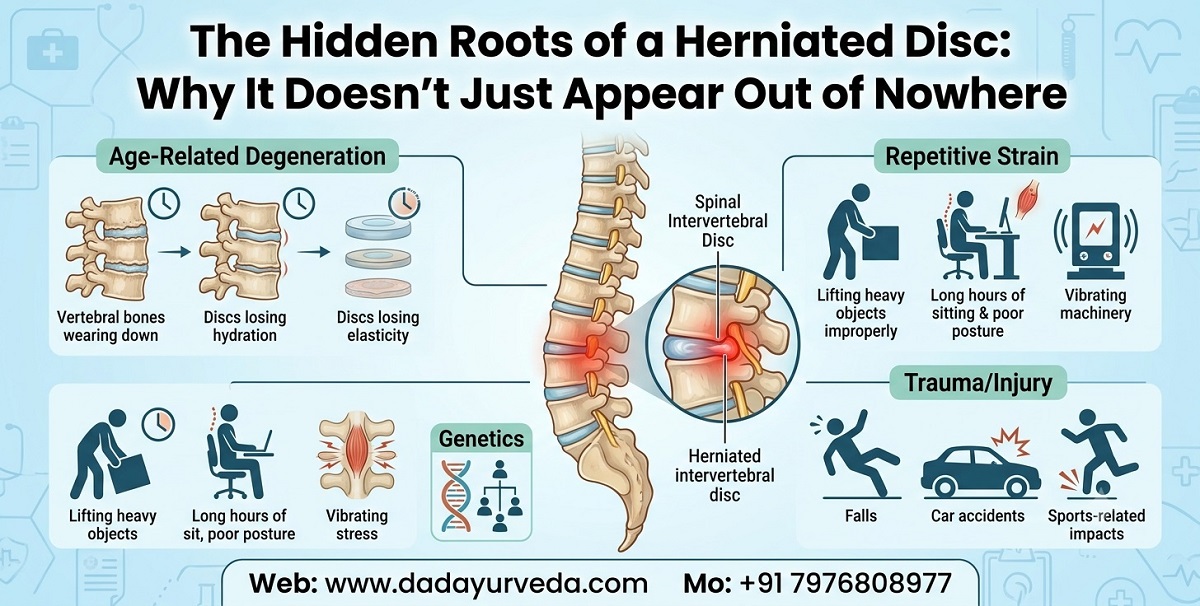
The Hidden Roots of a Herniated Disc: Why It Doesn’t Just Appear Out of Nowhere
A herniated disc rarely strikes without warning. While most people focus on the sudden back pain, sciatica, or limited mobility, the real story often begins much earlier—in the silent, unseen pressures we carry every day.
According to insights shared by Dr. Pankaj Rohilla, a herniated disc takes root in places no one sees. The body eventually reflects the load the mind and emotions have been shouldering for too long.
The Unseen Contributors
Emotional overload
Lifting more than you should… and refusing to stop. Constant emotional weight—worries, responsibilities, unresolved stress—accumulates until the spine can no longer support it alone.
Emotional rigidity
Difficulty bending, changing, or being flexible. When life demands adaptability but we stay locked in rigid patterns of thinking or living, the physical body often mirrors that stiffness.
Lack of support
Feeling like you have to handle everything alone. The belief that asking for help is weakness keeps many people isolated under heavy burdens. The spine, quite literally, ends up carrying what no one else is sharing.
Excessive control
Trying to manage everything, all the time. The need to control every outcome creates chronic tension. Muscles stay tight, posture suffers, and discs take the strain.
Constant pressure
Unrelenting demands, responsibilities, and tension. Work deadlines, family obligations, financial worries—the never-ending list keeps the nervous system in high alert and the body under continuous load.
Extreme exhaustion
Pushing yourself to keep going… even when you’ve reached your limit. Ignoring fatigue is common, yet the body eventually forces a stop through pain and injury.
Fear of losing stability
Insecurity regarding money, work, or the future. This deep-seated fear keeps the body in a protective, braced state that restricts natural movement and recovery.
Inner conflict
One part of you wants to stop… but the other won’t let you. This internal tug-of-war creates persistent tension that the musculoskeletal system cannot sustain indefinitely.
The heavier the load you carry—physically, emotionally, or mentally—the sooner your body feels the impact. A herniated disc is often the body’s way of saying the burden has become too great.
Healing Beyond the Disc: Specific Ayurvedic Therapies
True recovery addresses both the structural issue and the deeper patterns that contributed to it. In Ayurveda, conditions resembling herniated disc or lumbar disc disorders are primarily understood as Vata imbalances (often linked to Gridhrasi or Katigraha). Treatment focuses on pacifying aggravated Vata, nourishing spinal tissues, reducing inflammation, improving lubrication of the discs, and supporting systemic balance.
Key classical and clinically used therapies include:
Kati Basti (Kati Vasti)
A signature localized therapy. A ring of black gram dough is formed over the lower back (lumbosacral region), and warm medicated oil is retained in it for 30–45 minutes. Oils commonly used include Mahanarayana Taila, Ksheerabala Taila, or Vishagarbha Taila. This deeply nourishes paraspinal muscles and discs, reduces spasm and local inflammation, soothes irritated nerve roots, and improves flexibility. It is particularly helpful for lumbar disc pain, sciatica, and mild-to-moderate disc herniation or degeneration.
Abhyanga (Therapeutic Oil Massage)
Warm medicated oils (such as Mahanarayana Taila, Dhanwantharam Taila, or Ksheerabala Taila) are massaged over the body or specifically along the spine. This improves circulation, reduces muscle stiffness and guarding, calms Vata, and prepares the tissues for deeper therapies.
Swedana (Sudation / Herbal Fomentation)
Herbal steam or bolus therapies such as Nadi Sweda, Patra Pinda Sweda (leaf poultice), or Njavara Kizhi (medicated rice bolus) follow oleation. Heat and herbs relax tight muscles, open channels, reduce stiffness, and enhance the penetration of oils.
Basti (Medicated Enema Therapy)
Considered one of the most powerful systemic treatments for Vata-dominant spinal disorders.
- Anuvasana Basti (oil-based) nourishes and lubricates tissues.
- Niruha or Kashaya Basti (decoction-based) helps clear deeper Vata and associated toxins.
Courses such as Matra Basti, Kala Basti, or specialized preparations like Panchatikta Ksheera Basti are often used. These support nerve health, reduce degenerative progression, and provide both local and systemic relief when combined with external therapies.
Supportive measures
Oral Ayurvedic formulations (for example Trayodashanga Guggulu and other Guggulu-based preparations, Ashwagandha, and Vata-pacifying decoctions) may be prescribed alongside external treatments. Lifestyle guidance, appropriate rest, and gentle supportive practices help prevent recurrence by addressing the emotional and physical “load” that contributed to the problem.
These therapies are individualized after proper assessment (including clinical evaluation and, where relevant, imaging). They are administered under the guidance of qualified Ayurvedic physicians and are not a substitute for emergency care in cases of severe neurological deficit.
Care at Disha Arogya Dham
At Disha Arogya Dham Ayurveda & Naturopathy Chikitsalya & Research Center in Jaipur, treatment focuses on restoring balance through these classical approaches while also supporting the whole person—body, mind, and daily habits.
Best Treatment in Jaipur
Contact: Disha Arogya Dham Ayurveda & Naturopathy Chikitsalya & Research Center
Call & WhatsApp: +91-7976808977 / 9034100716
Address: 348/4c Jamunapuri, Murlipura, Jaipur 302039
If your back is speaking, it may be time to listen—not only to the pain, but to the deeper message behind it. Healing becomes more complete when we address both the disc and the load that helped create it.