



Uncategorized
Bachelor of Naturopathy and Yogic Sciences
Aug
Bachelor of Naturopathy and Yogic Sciences (BNYS): Golden Opportunity to Become a Doctor in Naturopathy & Yoga – NEET Not Required
Looking for a rewarding career in holistic healthcare without the pressure of NEET? The Bachelor of Naturopathy and Yogic Sciences (BNYS) offered by Disha Arogya Dham Group of Institutions in Jaipur is redefining future education in natural healing and yogic sciences.
This professional undergraduate program trains you to become a qualified Naturopathy Doctor and Yoga expert, combining ancient wisdom with modern scientific understanding of the body’s natural healing abilities.
What is BNYS – Bachelor of Naturopathy and Yogic Sciences?
BNYS (Bachelor of Naturopathy and Yogic Sciences) is a specialized medical degree focused on drugless, natural therapies and yogic practices. It equips students with knowledge of anatomy, physiology, nutrition, hydrotherapy, yoga therapy, acupuncture, lifestyle medicine, and more.
Unlike conventional allopathic paths, BNYS emphasizes prevention, holistic wellness, and treating the root cause of disease through nature’s elements — air, water, earth, fire, and ether — along with yoga and diet.
Key Highlights of the Course at Disha Arogya Dham:
- Duration: 4 years 5 months (as per institution details)
- Eligibility: 10+2 in PCB, Arts, or Math from a recognized board
- NEET Not Required – Direct admission opportunity
- Limited Seats: Only 50 seats available
- Focus on practical training at India’s leading Ayurveda and Naturopathy Hospital and Research Centre
Why Choose BNYS at Disha Arogya Dham, Jaipur?
Disha Arogya Dham Group of Institutions positions itself as one of India’s top Ayurveda and Naturopathy Hospital and Research Centres. Located at 348/4 Jamunapuri, Murlipura, Jaipur-302039 (Rajasthan), the institution offers hands-on clinical exposure in a real hospital setting.
Advantages:
- No NEET score needed for admission
- Broader eligibility (PCB, Arts, or Math streams accepted)
- Strong emphasis on job-oriented training
- Opportunity to become a registered practitioner in Naturopathy & Yoga
Career Opportunities After BNYS – High Demand in Wellness Sector
Graduates of Bachelor of Naturopathy Yogic Sciences enjoy excellent career prospects in India’s booming wellness, AYUSH, and preventive healthcare industries. Popular job roles include:
- Government Medical Officer (AYUSH/Naturopathy)
- Naturopathy Physician / Consultant
- Yoga Consultant / Therapist
- Acupuncture Physician
- Nutritionist / Diet Consultant
- Wellness Consultant (Corporate / Resorts / Spas)
- Medical Research Officer / Scientist
- Hospital Management / Administration
- Academics / Lecturer in Naturopathy & Yoga colleges
- Hospitality & Wellness Management roles
With rising awareness of lifestyle diseases and preference for side-effect-free treatments, BNYS doctors are in demand at government AYUSH hospitals, private naturopathy clinics, yoga centers, wellness resorts, research institutions, and corporate wellness programs. Many graduates also start their own successful private practice.
Admission Details – Act Fast, Only 50 Seats
Eligibility: Passed 10+2 with PCB, Arts, or Mathematics Course Duration: 4 Years 5 Months Seats: Limited to 50 only
Contact for Admission: 📞 7976808977 / 9034100716 🌐 Website: www.dadayurveda.com 📍 Address: 348/4 Jamunapuri, Murlipura, Jaipur-302039 (Rajasthan)
Why Naturopathy & Yoga is the Future of Healthcare
People across India and the world are shifting toward natural, preventive, and holistic healthcare. BNYS graduates play a vital role in managing chronic conditions, promoting mental and physical wellness, and supporting the government’s AYUSH initiatives.
If you are passionate about natural healing, yoga, and helping people live healthier lives without heavy reliance on drugs, this is your golden opportunity to become a Doctor in Naturopathy & Yoga.
Don’t miss out — seats are limited. Call now and take the first step toward a fulfilling career in one of the fastest-growing healthcare fields.
Disha Arogya Dham Group of Institutions – Redefining Future Education in Ayurveda, Naturopathy & Yogic Sciences.
SEO Keywords integrated: Bachelor of Naturopathy Yogic Sciences, BNYS course, BNYS admission Jaipur, Naturopathy doctor course without NEET, Yoga and Naturopathy education, career in Naturopathy, BNYS eligibility, Disha Arogya Dham, Naturopathy Physician, Yoga Consultant, etc.
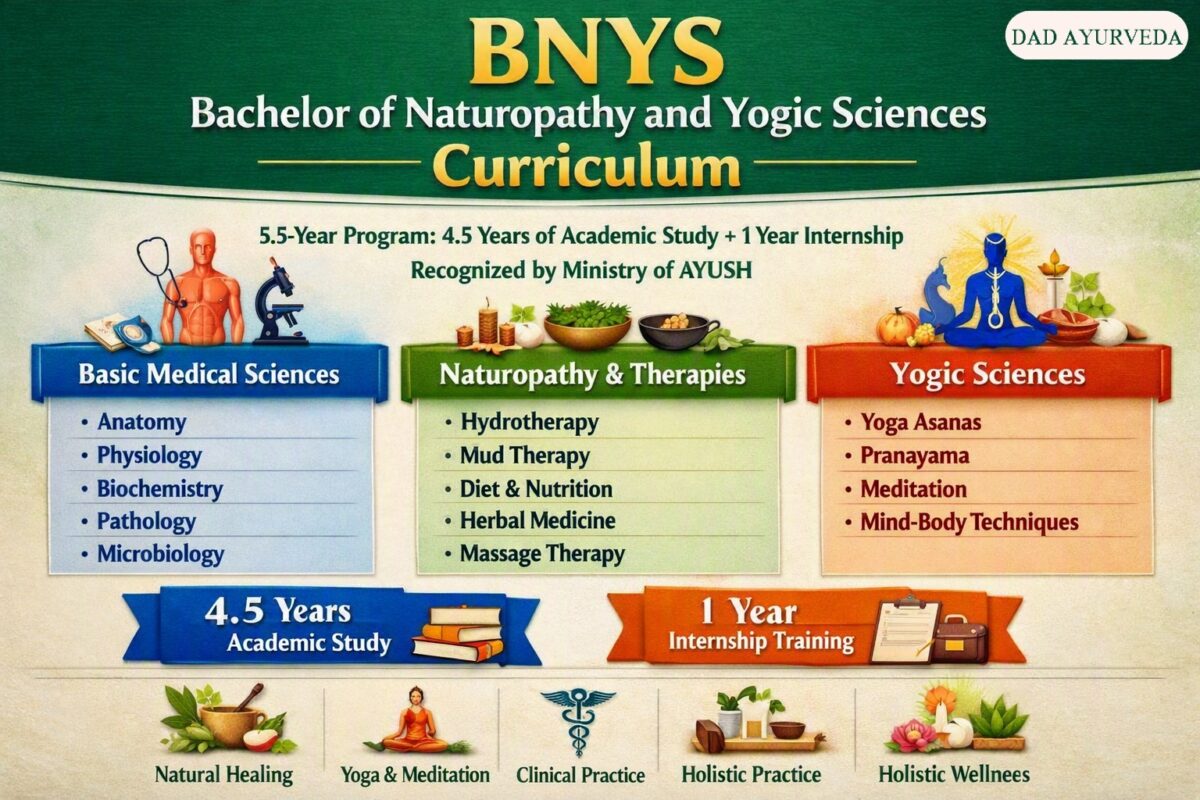
BNYS (Bachelor of Naturopathy and Yogic Sciences) Curriculum Details
The BNYS program is a 5.5-year undergraduate medical degree (typically 4.5 years of academic study + 1 year of compulsory rotational internship). It is recognized under the Ministry of AYUSH and aims to train practitioners in natural healing, yogic sciences, and basic medical sciences.
The curriculum blends:
- Pre-clinical and para-clinical medical subjects (similar to other medical degrees)
- Core Naturopathy principles and therapies
- Yoga philosophy, practices, and therapeutic applications
- Clinical training and research
Syllabus can vary slightly by university, but the structure approved/referenced by the National Institute of Naturopathy (NIN, Pune) and most institutions is standardized as follows:
Overall Structure
| Phase | Duration | Focus |
|---|---|---|
| 1st Year | 18 months | Pre-clinical sciences + Foundations of Naturopathy & Yoga |
| 2nd Year | 12 months | Para-clinical subjects + Yoga & basic therapies |
| 3rd Year | 12 months | Clinical Naturopathy, Yoga applications & diagnostics |
| 4th Year | 12 months | Advanced clinical subjects, therapy techniques & management |
| Internship | 12 months | Compulsory rotational clinical postings |
Year-Wise Subjects (Standard Curriculum)
1st Year (18 months) Focus: Human body fundamentals + philosophical base
- Human Anatomy (I & II)
- Human Physiology (I & II)
- Biochemistry
- Philosophy of Naturopathy / Nature Cure (I & II)
- Principles / Philosophy & Practice of Yoga
- Sanskrit (often non-exam or basic)
- Practicals in all major subjects
2nd Year (12 months) Focus: Disease processes + early therapies
- Pathology (I & II)
- Microbiology
- Community Medicine / Social & Preventive Medicine
- Yoga Philosophy / Yoga & Physical Culture – I
- Basic Pharmacology
- Colour Therapy & Magneto-biology (Chromotherapy & Magnetotherapy)
- Forensic Medicine & Toxicology
- Practical training
3rd Year (12 months) Focus: Therapeutic techniques & diagnostics
- Manipulative Therapies (Massage, Chiropractic, Osteopathy, Aromatherapy)
- Acupuncture & Acupressure (sometimes including Reflexology)
- Yoga & Its Applications / Yoga & Physical Culture – II
- Nutrition & Medicinal Herbs / Dietetics & Herbology
- Diagnostic Methods in Naturopathy (e.g., facial diagnosis, iris diagnosis)
- Diagnostic Methods in Conventional / Modern Medicine
- Psychology & Basic Psychiatry
- Practicals
4th Year (12 months) Focus: Advanced clinical practice & management
- Fasting Therapy & Dietetics
- Obstetrics & Gynaecology
- Yoga Therapy
- Hydrotherapy & Mud / Clay Therapy
- Physical Medicine & Rehabilitation / Physiotherapy
- First Aid & Emergency Medicine
- Clinical Naturopathy
- Research Methodology & Recent Advances
- Hospital Management & Medical Ethics (in many institutes)
- Sometimes Chromotherapy, Acupuncture refinements, or Minor Surgery
Compulsory Internship (1 Year)
Rotational postings in:
- Naturopathy hospitals / OPD & IPD
- Yoga therapy departments
- Hydrotherapy, mud therapy, manipulative therapy units
- Diet & nutrition clinics
- Community health / AYUSH centres
- Sometimes allopathic exposure or specialized wellness centres
Students gain hands-on experience in patient care, case taking, therapy administration, and hospital routines.
Core Themes Across the Curriculum
- Naturopathy therapies: Hydrotherapy, mud therapy, fasting, diet therapy, chromotherapy, magnetotherapy, manipulative therapies, acupuncture/acupressure
- Yoga: Asanas, pranayama, meditation, kriyas, therapeutic yoga, philosophy (Patanjali Yoga Sutras, Hatha Yoga texts, etc.)
- Medical foundation: Anatomy, physiology, pathology, microbiology, community medicine
- Supporting areas: Nutrition, psychology, research, hospital administration, emergency care
Note: Exact subject titles, teaching hours, and paper divisions can differ slightly between universities (e.g., Rajiv Gandhi University of Health Sciences, Tamil Nadu Dr. MGR Medical University, Subharti University, S-VYASA, etc.). Always check the specific syllabus of the institution you are considering (such as Disha Arogya Dham Group of Institutions, which follows a similar framework adapted to their hospital-based training).
This curriculum prepares graduates to practice as Naturopathy physicians, Yoga therapists/consultants, and wellness professionals, with eligibility for registration under relevant AYUSH/Naturopathy boards.
BNYS vs BAMS Syllabus Comparison
Both BNYS (Bachelor of Naturopathy and Yogic Sciences) and BAMS (Bachelor of Ayurvedic Medicine and Surgery) are 5.5-year undergraduate medical programs under the AYUSH system (including 1 year of compulsory internship). They share some foundational modern medical sciences but differ significantly in philosophy, core focus, and therapeutic training.
Quick Overview
| Aspect | BNYS | BAMS |
|---|---|---|
| Full Form | Bachelor of Naturopathy and Yogic Sciences | Bachelor of Ayurvedic Medicine and Surgery |
| Core Philosophy | Drugless natural healing + Yoga | Classical Ayurveda (herbal, Panchakarma, surgery) |
| Main Focus | Naturopathy therapies, Yoga therapy, lifestyle & prevention | Ayurvedic diagnostics, herbal pharmacology, clinical Ayurveda |
| Regulator | Ministry of AYUSH / related boards | NCISM (National Commission for Indian System of Medicine) |
| Duration | 4.5 years academic + 1 year internship | 4.5 years academic + 1 year internship |
| Approach | Drugless / minimal drugs | Herbal medicines + procedures |
Year-Wise Syllabus Structure Comparison
Common Elements in Both
- Basic medical sciences: Anatomy, Physiology, Biochemistry, Pathology, Microbiology, Community Medicine
- Some exposure to Yoga and preventive health
- Clinical training + 1-year internship
Key Differences by Phase
1st Year / Professional (≈18 months)
- BNYS: Anatomy (I & II), Physiology (I & II), Biochemistry, Philosophy of Naturopathy, Principles/Practice of Yoga, Sanskrit (basic)
- BAMS: Rachana Sharira (Anatomy), Kriya Sharira (Physiology), Padartha Vigyan & Ayurveda Itihas (philosophy & history), Sanskrit, Samhita Adhyayan (classical texts like Ashtanga Hridaya), electives
→ BNYS starts with Naturopathy & Yoga foundations. BAMS emphasizes Ayurvedic philosophy, history, and classical texts.
2nd Year / Professional
- BNYS: Pathology, Microbiology, Community Medicine, Yoga Philosophy / Physical Culture, Basic Pharmacology, Colour & Magneto-therapy, Forensic Medicine
- BAMS: Dravyaguna Vigyan (herbal pharmacology & materia medica), Rasashastra & Bhaishajya Kalpana (Ayurvedic pharmaceutics – minerals/metals), Roga Nidan & Vikriti Vigyan (pathology & diagnostics), Charaka Samhita (Purvardha), Agadtantra (toxicology), Swasthavritta & Yoga
→ BNYS introduces early natural therapies (colour, magneto). BAMS focuses heavily on herbal drugs, medicine preparation, and classical diagnosis.
3rd Year / Professional
- BNYS: Manipulative Therapies (massage, chiropractic, etc.), Acupuncture & Acupressure, Yoga Applications, Nutrition & Medicinal Herbs, Diagnostic Methods (Naturopathy + Conventional), Psychology & Basic Psychiatry
- BAMS: Swasthavritta (preventive health), Prasuti Tantra & Stri Roga (OBG), Kaumarbhritya (Paediatrics), Agadtantra (if not earlier), Charaka Samhita (Uttarardha), more clinical exposure
→ BNYS stresses hands-on natural therapies and diagnostics. BAMS expands into specialised clinical Ayurveda (women’s health, paediatrics).
4th / Final Professional Year
- BNYS: Fasting Therapy & Dietetics, Yoga Therapy, Hydrotherapy & Mud Therapy, Physical Medicine & Rehabilitation, Obstetrics & Gynaecology, Clinical Naturopathy, First Aid & Emergency, Research Methodology, Hospital Management
- BAMS: Kayachikitsa (Internal Medicine including psychiatry, Rasayana, Vajikarana), Panchakarma, Shalya Tantra (Surgery), Shalakya Tantra (ENT, Eye, Dentistry), Research Methodology & Medical Statistics, Emergency Medicine
→ BNYS deepens drugless therapies (hydro, mud, fasting, advanced yoga). BAMS is highly clinical with internal medicine, detox procedures (Panchakarma), and Ayurvedic surgery/ENT.
Core Subject Focus Comparison
| Area | BNYS Emphasis | BAMS Emphasis |
|---|---|---|
| Philosophy | Naturopathy principles + Yoga philosophy | Padartha Vigyan, Ayurvedic history & texts |
| Therapeutics | Hydrotherapy, Mud, Fasting, Manipulative, Acupuncture, Diet | Panchakarma, Herbal formulations, Rasayana |
| Pharmacology | Basic + limited herbs | Extensive Dravyaguna + Rasashastra |
| Surgery / Procedures | Minimal / none | Shalya Tantra (Ayurvedic surgery) |
| Yoga | Extensive (philosophy + therapy) | Present but secondary (mainly in Swasthavritta) |
| Classical Texts | Limited | Heavy (Charaka, Sushruta, Ashtanga Hridaya) |
| Modern Sciences | Strong foundation | Strong foundation + integration |
Summary of Differences
- BNYS is more oriented toward drugless, natural, lifestyle-based, and Yoga-centric healing. It trains practitioners for wellness centres, naturopathy hospitals, yoga therapy, and preventive care.
- BAMS is a full Ayurvedic clinical medical degree with deeper training in herbal medicine, classical diagnosis/treatment, Panchakarma, and limited surgical aspects. Graduates can practice as Ayurvedic doctors with broader clinical roles.
Both degrees allow the use of the “Dr.” prefix (as per applicable regulations) and registration under relevant AYUSH boards, but the scope of practice differs based on the system.
Note: Exact subjects and teaching hours can vary slightly by university. Always refer to the specific institution’s syllabus (e.g., NCISM for BAMS; NIN Pune / university guidelines for BNYS) for the most accurate details.